The one everyone comes for
Pena Palace
A yellow-and-red Romanticist palace on Sintra's highest peak, where King Ferdinand II built his vision on top of a ruined hilltop monastery.
Pena is the one nobody skips, and the crowds prove it. King Ferdinand II raised this in the 1840s and 50s on the ruins of an old hilltop monastery, painting it canary-yellow and ox-blood red so it would read from miles off. You enter under the Triton gateway — a snarling half-man, half-fish that appears to carry the whole palace on his back, meant to stand for the creation of the world. Inside, the route runs one-way: the Stag Room with its circular table around a central pillar, the Arab Room's trompe-l'oeil domed ceiling, King Carlos's painting studio, the Great Hall. The detail we send people to find is in the kitchen, where the copper pots are stamped "PP" so staff couldn't walk off with them. Then out to the Queen's Terrace and the ochre Pátio dos Arcos for the view.
The copper pots in the royal kitchen are stamped "PP" — for Pena Palace — so the staff couldn't quietly walk off with them.
What to see
- The Triton gateway — a snarling half-man, half-fish that looks like it's carrying the New Palace on its back
- The kitchen copper pots stamped 'PP' so they couldn't be stolen — the most human detail in the place
- The Arab Room's trompe-l'oeil domed ceiling and the Stag Room's circular banquet table around a central pillar
- The Queen's Terrace and the ochre Pátio dos Arcos (Courtyard of Arches) for the long Atlantic views
- The Chalet of the Countess of Edla down in the park — cork walls, vine-painted ceilings, almost empty
Cruz Alta, the park's highest point, is signposted like a prize but it's a let-down for palace photos — you can't actually see the palace from up there. The shot everyone wants is from Alto do Chá (Alto de Santa Catarina) instead, where the whole yellow-and-red front lines up.
Why visit Pena
If you have one day in Sintra, this is the anchor — we'd build everything else around it. The colour, the Triton, the terrace views over the Atlantic and the green folds of the Serra: it earns the queue. But go in clear-eyed. The interior is a single-file conveyor of rooms with no backtracking, the terraces bottleneck at peak, and a flat hour here will leave you frustrated. Who should skip it? Almost no one on a first visit — but if you genuinely loathe crowds and can't take the first slot, you'll have a better morning at Regaleira or Monserrate and come back for Pena another time. The thing most people undervalue is the park: the Chalet of the Countess of Edla, with cork-clad walls and vine-painted ceilings, is barely visited and worth the downhill walk.
The full story
The site began as a hilltop chapel raised in the 12th century after reported Marian apparitions. In 1503 King Manuel I ordered a monastery here for the Hieronymite friars; the surviving Manueline Cloister, built in 1511, is tiny because the community was tiny, its two storeys of arches wrapped in geometric Hispano-Mudéjar cuerda-seca tilework around a square patio. The 1755 earthquake cracked it, the friars left around 1834, and in 1838 the consort king Ferdinand II bought the ruin with his own money. His chosen man, Wilhelm Ludwig von Eschwege, was a mining engineer and mineralogist, not an architect, which partly explains the result: two wings, an Old Palace inside the former monastery and a New Palace of state rooms, wired together with drawbridge, tunnels and parapet walks. Look for the Great Hall, which doubled as the billiards room until the table went in 1940; it carries a 72-candle chandelier and Ferdinand's Asian porcelain. The Stag Room, the banquet hall, mounts real antlers on plaster stag heads. Down in the park, the Valley of the Lakes strings five linked pools with duck houses shaped like the castle and palace, and the Queen's Fern Valley grows Australian and New Zealand tree ferns under merged oak crowns. Queen Amelia left for good on 5 October 1910; UNESCO listed the whole landscape in 1995.
Getting there
Take the 434 bus from outside Sintra station — about 17 minutes uphill, running every 5–10 minutes in peak. It drops you at the park gate, but you're still facing a steep 10–15 minute walk up to the palace itself; a paid shuttle covers it but builds its own queue. Aim to arrive about an hour before your slot. Walking up from town is a demanding ~55-minute climb — most people don't, and we don't suggest it on a hot day.
Plan your visit
Timed entry is strictly enforced — miss your slot and you can be refused entry to the interior. The 434 drop-off is not the palace; there's a steep uphill walk still to come. And mist on the heights is common and can grey out the view even on a clear day in town, so don't bank everything on the panorama.
Treating Pena as a one-hour stop. People rush the one-way interior, then hit the terrace bottleneck at the worst time and leave annoyed. The other classic error: buying a park-only ticket and discovering at the door it does not include the palace interior rooms.
Accessibility
The site is steep throughout. From the park gate it's still a 10–15 minute climb uphill to the palace doors; a paid shuttle covers that stretch but generates its own queue. The interior route involves stairs and uneven historic floors. The terraces and Pátio dos Arcos involve more steps. If walking is hard, plan around the shuttle and accept some sections will be tough.
Good to know
- No cars reach the gate. You either ride bus 434 up from Sintra station or walk in on foot, then face an uphill climb from the entrance to the palace itself.
- The internal electric shuttle between the gate and the palace was flagged out of service when we last checked, so don't count on a ride up the hill. Check current status before you go.
- Two ways in: the Main Entrance and the lower, usually quieter Lakes Entrance, which drops you straight into the Valley of the Lakes sub-zone.
- Food is sorted up top: a restaurant and cafeteria sit in the former neo-Indian stables building (roughly 10:00-18:00), plus a kiosk near the entrance. The Lakes Cafeteria was flagged temporarily closed, with a vending machine near the main entrance as the fallback.
- Climb to the High Cross (Cruz Alta) at 528m, the highest point in the Sintra hills, for views south to Lisbon and Cascais and west to the Atlantic. The current cross is a single 3.5m limestone block from 2008.
- Prefer to skip the bus queue? Three marked trails walk up from town: Santa Maria (1.77km, about 1h), Villa Sassetti (1.85km, about 45min) and Seteais (2.41km, about 1.5h).
- Terrain is steep and cobbled, and the palace involves stairs (including the double staircase to the cloister). Detailed step-free and wheelchair access specifics weren't confirmable for us, so verify on the official accessibility page if you need them.
Stand under the Triton gateway and look up — the snarling half-man, half-fish appears to hold the whole palace on his back, and it's meant to represent the creation of the world. It's the one image that captures what Ferdinand was after.
Pena Palace: your questions
How early do I really need to book, and which slot?
Book days ahead in peak season — mid-morning and post-lunch slots sell out first. Take the first entry around 9:30am opening; it's the single best thing you can do for crowds, photos and the whole day's pace.
Does a park ticket get me inside the palace?
No. A park-only ticket covers the grounds — the Valley of the Lakes, the Chalet of the Countess of Edla — but not the palace interior rooms. If you want to see the Stag Room, Arab Room and the rest, you need the ticket that includes the interior.
How do I get up there from Sintra station?
Take the 434 bus from outside the station, about 17 minutes uphill, every 5–10 minutes in peak. It leaves you at the park gate, from where it's still a steep 10–15 minute climb to the palace. A paid shuttle covers that last stretch but has its own queue.
What happens if I'm late for my timed slot?
Timed entry is strictly enforced and you can be refused entry to the interior if you miss it. Build in buffer: arrive about an hour before your slot, since the bus, the queue and the uphill walk all eat time you won't get back.
Where's the best place to photograph the palace?
Not from Cruz Alta — the park's highest point doesn't actually give you a view of the palace. Head to Alto do Chá (Alto de Santa Catarina), where the full yellow-and-red facade lines up. From inside, the Queen's Terrace and the ochre Pátio dos Arcos are the strongest angles.
Can I drive up to Pena Palace?
No. Private vehicles aren't allowed up to the monument. You park in central Sintra or a peripheral car park, then come up on foot or by the 434 circuit bus from Sintra station. The final approach is never by car, so plan for the walk or the bus either way.
Is there anywhere to eat at Pena?
Yes. A restaurant and a terrace cafeteria occupy the upper floors of the former stables building near the palace, serving hot dishes, salads, sandwiches, pastries, regional sweets and drinks including wine and beer, roughly 10:00 to 18:00. There's also a kiosk near the entrance. Dietary needs are accommodated on request.
What's worth seeing in the park beyond the palace?
Plenty. The Valley of the Lakes has five linked pools with castle-shaped duck houses and the tiled, acoustic Little Birds Fountain pavilion. The Queen's Fern Valley grows tree ferns from Australia and New Zealand under a canopy of merged oaks. Then climb to the High Cross viewpoint at the very top.
Explore more of Sintra
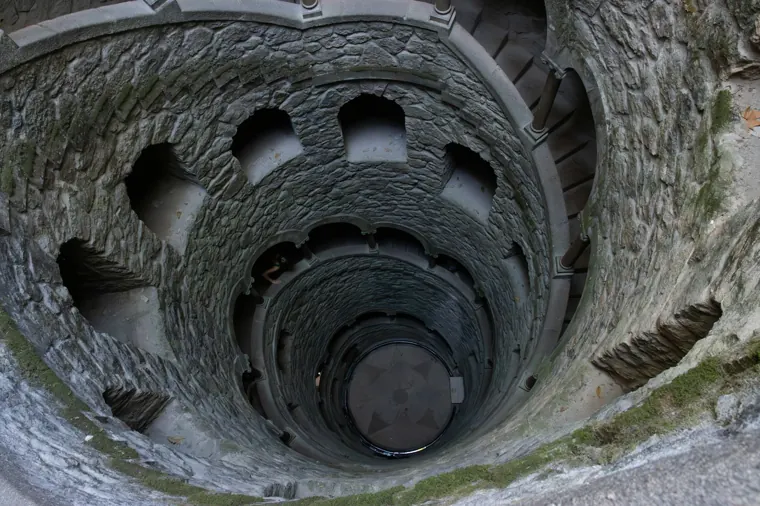 The one you walk into, not up
 Quinta da Regaleira
An early-1900s estate built as a coded garden — the descend-the-well-and-exit-the-tunnel move is the whole point.
Read the guide →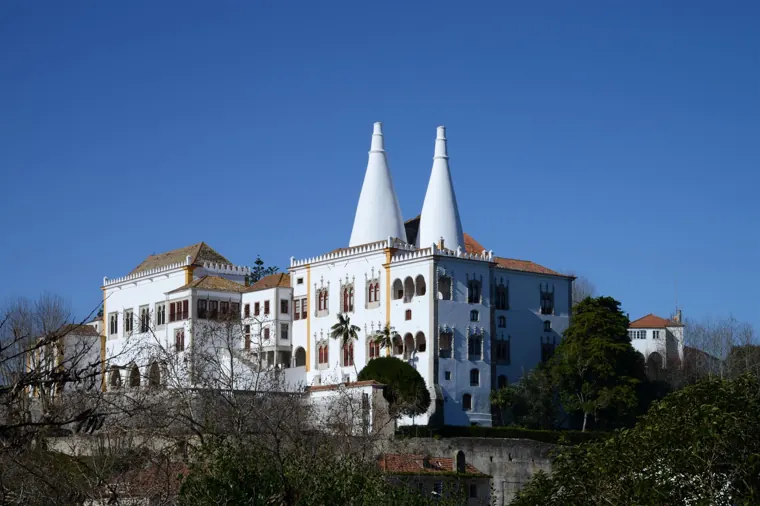 The tower everyone underrates
 Sintra National Palace
The town-centre palace people photograph from the square and then walk straight past.
Read the guide →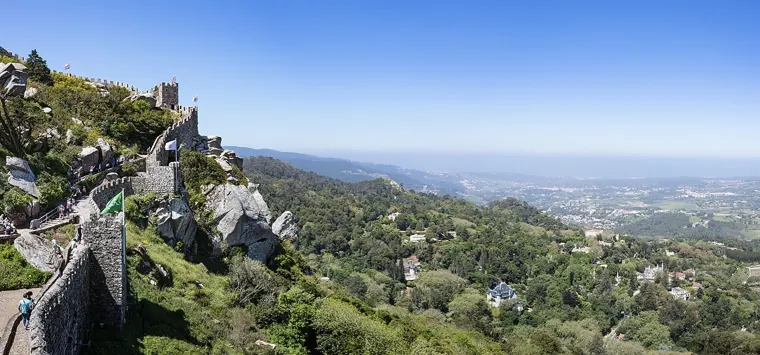 Half ruin, half romantic rebuild
 Moorish Castle
An 8th-century Moorish fort, rebuilt in the 1800s, with the best Pena view in Sintra.
Read the guide →