The tower everyone underrates
Sintra National Palace
Two white cones, 33 metres tall, mark the kitchens of the oldest royal palace in Portugal still standing in the middle of town.
Here's the trap with Sintra National Palace: you'll see those two white conical chimneys from the square, decide it's "just a tower," and keep walking up to Pena. Don't. This is the best-preserved medieval royal palace in Portugal, lived in by royalty for centuries, and the interior is where it earns its place. The Swan Room ceiling is painted with swans wearing gold collars. The Magpie Room sets roughly 136 birds across the ceiling, each holding a "por bem" scroll. The Coats-of-Arms Room carries a Manueline coffered dome studded with 72 noble shields — one of the great heraldic ceilings in Europe. And the azulejo collection running through these rooms has no real rival in the country. Then there are the kitchens, where you stand directly beneath those two 33-metre cones you saw from outside. It's flat, it's central, and it's far more than a silhouette.
Those two white cones over the town square aren't decoration or a tower — they're the chimneys of the palace kitchens, and from inside you can look straight up 33 metres to daylight.
What to see
- The Swan Room — a ceiling of swans in gold collars, a nod to Philippa of Lancaster
- The Magpie Room — roughly 136 birds, each gripping a 'por bem' scroll across the ceiling
- The Coats-of-Arms Room — a Manueline domed ceiling carrying 72 noble shields
- The kitchens, standing directly under the two 33-metre conical chimneys
- The azulejo collection — the densest, oldest run of decorative tilework of any palace in Portugal
In the kitchens, stop and look straight up the inside of the two cones. Most people glance at the fireplaces and move on — but tilt your head back and you'll see the full 33-metre funnel of each chimney narrowing to a circle of daylight at the top. It's the one view here you can't get anywhere else.
Why visit National Palace
If your day is tight and you're choosing between this and Pena or Regaleira for the headline moment, those two win — we won't pretend otherwise. But this palace asks almost nothing of you: it's in the middle of town, the route is flat, and you're in and out in an hour. That changes the maths. You don't have to "spend" a half-day on it; you fold it into the gaps between the big two. Our team would send anyone who likes interiors — painted ceilings, tilework, the texture of a place that was actually inhabited rather than built as a fantasy — straight in. Skip it only if you're a single-day visitor laser-focused on the clifftop castles and genuinely cannot spare 60 minutes. Almost everyone can.
The full story
There's a thousand years layered into this building, and the fixed route makes you walk through it. The first documented palace dates to a 1281 contract between King Dinis and the free Moors of Colares; Sintra then sat at the heart of the Queens' Lands, administered by Portugal's queens, which is why so many rooms carry a queen's name. The circuit starts at the Arcades, the open loggia where the Queen's notaries once drew up wills, sealed contracts and settled disputes. It was a working law office, not just an entrance. From there the one-way loop threads roughly 20 named spaces, and the quieter ones reward attention: the Galley Room, whose 17th-century ceiling shows Portuguese, Ottoman and Dutch ships for reasons now lost; the Golden Chamber, once finished in gold, where Catherine of Austria held court and King Sebastião slept. The darkest stop is the Chamber of Afonso VI, the palace's oldest section, where the deposed king was held nine years (1674 to 1683) under 300 guards until his death, on ceramic flooring laid around 1430 to 1440, among the oldest tile floors in Portugal. The Chapel, original to King Dinis, keeps one of the best-preserved Mudéjar ceilings in the country. End at the Water Grotto, where plasterwork by Giovanni Grossi's workshop maps the Creation of the World, the Four Seasons and assorted myths overhead, water jetting from pinholes in the walls.
Getting there
It's in the centre of Sintra-Vila, so getting there is the easy part. From the train station it's a level walk of about 15 minutes up into town — no hill, unlike everything else here. If you'd rather ride, it's the first stop on the 434 (the castles loop) and the 435 (the palaces loop), both of which you catch just outside the station. Most people simply walk; you'll arrive at the square right in front of the chimneys.
Plan your visit
The route runs single-file through the rooms, and it jams at the Magpie and Swan rooms once the mid-day coaches land. If you hit it at peak you'll be shuffling shoulder-to-shoulder past the best ceilings. Come early or late and you'll have room to actually stop and look up.
Standing in the square, photographing the chimneys, deciding the place is "just a tower," and walking on up to Pena. People do this constantly — and skip the oldest continuously inhabited royal palace in Portugal, with a tile collection nothing else in the country matches. The outside is the least of it; the rooms are the reason to go in.
Accessibility
The approach is flat — no hill climb, unlike Pena or the Moorish Castle. Inside it's an older palace with level changes and stairs between rooms, and the route is one-way, so it's manageable for most walkers but not step-free throughout.
Good to know
- Don't drive in. Private cars are barred from the historic centre (residents only) and there's no on-site parking, so use a town car park and walk or grab bus 434/435. From Lisbon, take the train (Rossio, Oriente or Entrecampos) and it's a 10 to 15 minute walk from Sintra station.
- The gardens are free and need no ticket. They terrace westward, and the Preta Garden is a first-level viewpoint over the Sintra hills and old town, built around a giant Manueline twisted column moved here from the palace's old entrance square.
- There's a café in the Lion Patio, an interior courtyard with a Moorish-style water feature and a terrace, reachable from outside without a monument ticket. It was flagged temporarily closed on the official site, so check current status before counting on it.
- This is a multi-level historic building with stairs, including a spiral staircase off the Central Patio. The town palace's specific step-free routes and lifts aren't published, so contact the official site directly to confirm access before you go.
- Assistance dogs are allowed when properly identified, with water bowls provided, and mobility-support services can be pre-booked. A justified reduced-mobility companion is admitted free.
- The ticket office shuts for an hour midday (12:00 to 13:00), but the automatic vending machines stay available. Palace and gardens run 09:30 to 18:30, last admission 18:00.
- Travelling with kids, ask about the treasure-hunt activity. The official site also offers a 360-degree virtual visit and a ZoomGuide that most third-party guides never mention.
Stand in the kitchens and look straight up the inside of a chimney cone to the daylight 33 metres above — then you'll understand what those two white shapes over the town actually are.
Sintra National Palace: your questions
Is it really worth going in, or is it just the chimneys you see from outside?
Worth going in, easily. The exterior silhouette is the least interesting part. Inside are the Swan Room, the Magpie Room with its roughly 136 scroll-carrying birds, the Coats-of-Arms domed ceiling with 72 shields, and the country's densest azulejo collection. An hour indoors is the whole point.
What's the story behind the swans on the ceiling?
The Swan Room ceiling is painted with swans in gold collars, linked to Philippa of Lancaster. You'll hear a line that there's one swan for each year of the bride's age — treat that as legend rather than documented fact. The room is worth it regardless of how the count works out.
How does it compare to Pena Palace — should I do both?
They're different animals. Pena is the clifftop showpiece; this is the lived-in medieval palace in the town centre. If you have time for both, do both — this one is flat, central and quick. If you can only manage one and want the headline view, Pena wins. But most days have room for both.
How do I get there and how long does it take?
It's in the middle of Sintra-Vila — a flat 15-minute walk up from the train station, or the first stop on the 434 and 435 buses. Plan on 1 to 1.5 hours inside, more if you arrive when the coaches do and the single-file route slows down.
When is it least crowded?
First entry in the morning or the final hour before closing. It sits on every coach route, so it fills mid-day and the one-way path bottlenecks at the Magpie and Swan rooms. A timed early slot is the difference between standing still and actually seeing the ceilings.
Can I visit the Sintra National Palace gardens without buying a palace ticket?
Yes. The gardens are free to enter and need no ticket. They climb westward across several terraces, and the Preta Garden gives you a viewpoint over the Sintra hills and the historic centre, built around a large Manueline twisted column relocated from the palace's old entrance square. The other named areas, the Araucaria Garden, Kitchen Garden, Tanquinhos Patio and Princes' Garden, also share panoramic views.
Is there parking at the Sintra National Palace?
No. There's no parking on-site, and private vehicles are barred from the historic centre, which is restricted to residents. Park in one of the town car parks outside the centre and walk in, or use bus 434 or 435. If you're coming from Lisbon, the easiest route is the train to Sintra station, then a 10 to 15 minute walk.
How long does the self-guided route take and what order do you see things in?
The visit is a fixed one-way circuit of more than 20 named spaces, starting at the Arcades, so the building dictates your order rather than you. The standout rooms are spread across the loop: the Magpie and Swan ceilings early, then the Coats-of-Arms dome, the kitchen with its twin chimneys, the Afonso VI prison chamber and the Water Grotto. Allow unhurried time, since last admission is 18:00.
Explore more of Sintra
 The one everyone comes for
 Pena Palace
Sintra's most-photographed sight — book the first slot and treat it as a two-hour commitment, not a quick stop.
Read the guide →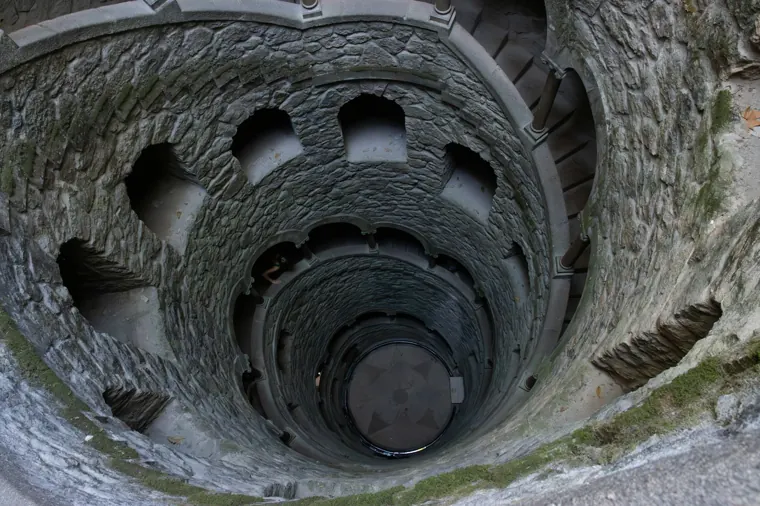 The one you walk into, not up
 Quinta da Regaleira
An early-1900s estate built as a coded garden — the descend-the-well-and-exit-the-tunnel move is the whole point.
Read the guide →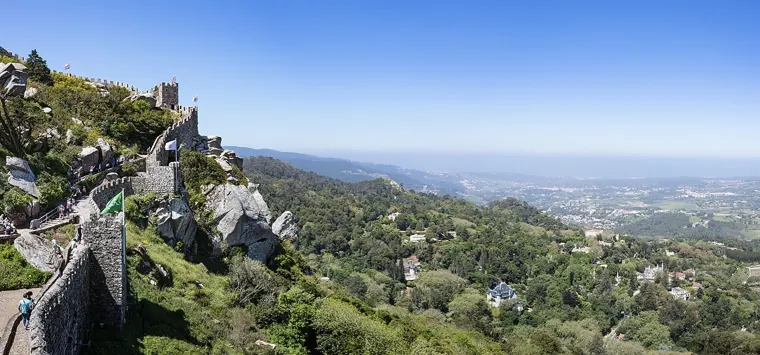 Half ruin, half romantic rebuild
 Moorish Castle
An 8th-century Moorish fort, rebuilt in the 1800s, with the best Pena view in Sintra.
Read the guide →